The Three and The One

mchang

Well-Known Member
Messages
64
Reaction score
19
Points
8
I was a member of a Taoist monastery @ 600CE. This lifetime it is my job to remember what I was taught so long ago and I suspect before then. It is my belief these concepts and ideas are what the adepts teach the initiates in small doses as they demonstrate their ability to master the principles. I was awakened this lifetime in the spring of 1997 and my consciousness shifted and I was led to learn. I did not know what Taoism was, I had never heard of it before then. I spent 2+ years reading and researching. Each ancient text I read led me to another and another.

At one point I was impressed to organize my thoughts and I did. I began writing. When I began I did not know what I was going to write about, but each day the ideas and thoughts came to me. Ultimately I wrote a 265 page paper with 365 footnotes. I am not a scholar. I could not help myself, I had to do this. I was manic about it. Every day the ideas and thoughts came to me from somewhere outside myself. Some people might call this automatic writing in today's vernacular. I don't know what to call it.

I know now that I needed to spend the time reading and researching so I could understand what they were trying to tell me, so I could remember and grasp the principles I had been taught before and put them on paper.

I have condensed this into a smaller easier to read piece I have posted here.

Be well, go in the light.

Brian
 

Attachments

Interesting document, thank you.

At first read, the only comment I would make is in the final section, with regard to compass references from the word's great traditions, no mention is made of the symbolism of the Cross, and that the Biblical texts are all from the Old Testament – Jewish rather than Christian.

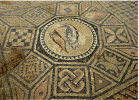
You mention the Megiddo Mosaic:

Screenshot 2026-07-05 at 17.33.08.png

The 'Ichths' is derived from the Greek word for fish, ἰχθύς, and is an acronym or acrostic:
"'Iησοῦς Χρῑστός Θεοῦ Υἱός Σωτήρ", which translates into English reads as "Jesus Christ, God's Son, Savior".

This mosaic has two fish in the centre of a circle, forty-eight points on its circumference, and eight squares outside of that.

The correspondences between the Symbolism of the Cross and its metaphysical interpretation and that of the Compass Wheel of the Dao is enough to show both traditions treat of the same ontological ideas.

It's worth also recalling that for the earliest followers of the Jesus Movement, they referred to it simply as 'The Way'.
 
Last edited:
Interesting document, thank you.

At first read, the only comment I would make is in the final section, with regard to compass references from the word's great traditions, no mention is made of the symbolism of the Cross, and that the Biblical texts are all from the Old Testament – Jewish rather than Christian.

You mention the Megiddo Mosaic:

View attachment 6124

The 'Ichths' is derived from the Greek word for fish, ἰχθύς, and is an acronym or acrostic:
"'Iησοῦς Χρῑστός Θεοῦ Υἱός Σωτήρ", which translates into English reads as "Jesus Christ, God's Son, Savior".

This mosaic has two fish in the centre of a circle, forty-eight points on its circumference, and eight squares outside of that.

The correspondences between the Symbolism of the Cross and its metaphysical interpretation and that of the Compass Wheel of the Dao is enough to show both traditions treat of the same ontological ideas.

It's worth also recalling that for the earliest followers of the Jesus Movement, they referred to it simply as 'The Way'.
Thomas: Howdy. I don't see where I mention the Megiddo Mosaic. I do show the image of Christ's name in Greek that lays out in the compass grid. I don't use or mention references from the New Testament, not out of any disrespect.

Sometime after I wrote this it dawned on me that in Genesis the tree of life is in the 'center' of the garden and the four rivers flow into this center. Rivers representing energy and I believe the tree of life representing our center within each of us. The fiery ever-turning sword is there to helps us return, not to keep us out.

Thanks. Brian
 
Thomas: Howdy. I don't see where I mention the Megiddo Mosaic. I do show the image of Christ's name in Greek that lays out in the compass grid.
They're both in Ephesus.

The eight-spoke wheel is, as you say, derived from writing the letters one atop the other, and has been seen, again at Ephesus, carved into the lintels over the doors of Christian houses.

I don't use or mention references from the New Testament, not out of any disrespect.
No problem.

Another compass device was the Chi=Rho:

monogram-of-christ384x389vatican.jpg Chrismon_Sancti_Ambrosii.jpg

The first is the more common, with 6 spokes, the second, with 8 spokes, less so.


Sometime after I wrote this it dawned on me that in Genesis the tree of life is in the 'center' of the garden and the four rivers flow into this center. Rivers representing energy and I believe the tree of life representing our center within each of us. The fiery ever-turning sword is there to helps us return, not to keep us out.
I think we need tread carefully here.

The first part I agree with – the garden radiates around the tree at its centre, the rivers flow to the four cardinal points of the compass, and the tree itself represents the vertical axis between this world, and the higher and lower realms.

We can say the symbolism has a correspondence with the same symbols or similar, which carry different meanings in different traditions.

What is not negotiable, IMHO, is rewriting the role of the cherubim to be the reverse of what the text actually declares. The discourse in Genesis 3 bears remarkable correspondences to other Ancient Near East mythologies, it being, after all, one strand of that common stock of stories, and in that respect the story addresses the idea of usurping heaven; of seeking to possess that which is not our possession by right but by gift.

So in your mythology the flaming sword device might well be a 'guiding light', but it was certainly not that in the minds of the authors of this and other such tales.
 
They're both in Ephesus.

The eight-spoke wheel is, as you say, derived from writing the letters one atop the other, and has been seen, again at Ephesus, carved into the lintels over the doors of Christian houses.


No problem.

Another compass device was the Chi=Rho:

View attachment 6126 View attachment 6127

The first is the more common, with 6 spokes, the second, with 8 spokes, less so.


I think we need tread carefully here.

The first part I agree with – the garden radiates around the tree at its centre, the rivers flow to the four cardinal points of the compass, and the tree itself represents the vertical axis between this world, and the higher and lower realms.

We can say the symbolism has a correspondence with the same symbols or similar, which carry different meanings in different traditions.

What is not negotiable, IMHO, is rewriting the role of the cherubim to be the reverse of what the text actually declares. The discourse in Genesis 3 bears remarkable correspondences to other Ancient Near East mythologies, it being, after all, one strand of that common stock of stories, and in that respect the story addresses the idea of usurping heaven; of seeking to possess that which is not our possession by right but by gift.

So in your mythology the flaming sword device might well be a 'guiding light', but it was certainly not that in the minds of the authors of this and other such tales.

Thomas, I'm only talking about what I know. A circle divided into eight quadrants. I have no knowledge of or background with other things like this and can't honestly comment, I don't know what the original intent of the six spoke wheel might be.

I'm pretty sure about the fiery ever-turning sword and it's purpose. I don't believe God punishes us, but guides us to do better. It's all about the meanings of the metaphors that have and probably were lost to others when they decided to write that God drove them out, could it be that by their actions, using their free will they drove themselves out. Their state of being went from one of being ONE and at peace to having their energy scattered and not at peace. I think a lot has been lost in antiquity from the oral tradition to the first written tradition. Thousands of years apart.

Take care.

Brian
 
Thomas, I'm only talking about what I know.
That's OK.

I'm pretty sure about the fiery ever-turning sword and it's purpose. I don't believe God punishes us, but guides us to do better.
I agree, but the point of the story is we were going about it the wrong way.

It's all about the meanings of the metaphors that have and probably were lost to others when they decided to write that God drove them out,
That's a way of reading it, but I'm sure there are Abrahamic exegetes who interpret the text differently.

... could it be that by their actions, using their free will they drove themselves out.
Yes. That's the point.

Their state of being went from one of being ONE and at peace to having their energy scattered and not at peace. I think a lot has been lost in antiquity from the oral tradition to the first written tradition. Thousands of years apart.
I think it's there, if one knows how to read it. The 'scattering of energies' is not the language the ANE would use.

It's about the exercise of the human will in pursuit of a perceived 'ephemeral' or 'illusory' good – a case of being in harmony with, or out of harmony with, the All.
 
That's OK.


I agree, but the point of the story is we were going about it the wrong way.

I'm not clear on what you mean by this?
That's a way of reading it, but I'm sure there are Abrahamic exegetes who interpret the text differently.


Yes. That's the point.


I think it's there, if one knows how to read it. The 'scattering of energies' is not the language the ANE would use.

It's about the exercise of the human will in pursuit of a perceived 'ephemeral' or 'illusory' good – a case of being in harmony with, or out of harmony with, the All.

Thanks brian
 
Back
Top