Rejected cover ...

Thomas

So it goes ...
Veteran Member
Messages
17,012
Reaction score
5,827
Points
108
Location
London UK
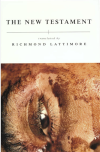
Chip Kidd, a quite famous US designer, did a cover for a translation of the New Testament:

Screenshot 2026-07-08 at 16.44.09.png

The image was actually that of a recently deceased male photographed in a US morgue.

Bookshops refused to stock it, and the major outlets refused to handle it, so the book was republished with a more anodyne image.

I've always liked it.
 
It is a shame to live in a puritanical culture where even death is not allowed to be seen.

Was this just in the US?
 
It is a shame to live in a puritanical culture where even death is not allowed to be seen.
At this stage I am not sure what to think. I don't know how the photo was obtained, what permission, if any, was given. There are the feelings of family and friends to consider too.
 
At this stage I am not sure what to think. I don't know how the photo was obtained, what permission, if any, was given. There are the feelings of family and friends to consider too.
Where I work (hospital) nobody enters the morgue without tons of permission. I know porters who take bodies to the morgue and there's no way you can just go in. There are only about three folks who are allowed in there. Judging by this I think it would be fair to assume a lot of papers had to be signed by lots of relevant people, especially kin.
 
At this stage I am not sure what to think. I don't know how the photo was obtained, what permission, if any, was given. There are the feelings of family and friends to consider too.
AFAIK, the photo was by Andres Serrano, a 'controversial' artist to say the least, the artist behind "Piss Christ" – a plastic crucifix in a vial of urine, whichI never rated as anything more than childish sensationalism.

The image was taken from a series of photographs of dead bodies in a US morgue. I think the individuals were 'unclaimed', and the provision was that no image should enable the body to be identified. Suffice to say the person depicted on the cover died a violent death at the hands of others.

Serrano is not alone in presenting corpses as art.

"In Andres Serrano’s series The Morgue ... The intense stylisation and composition of the images are a record of his (the artist's) unbridled artistic control... Andrea Fitzpatrick argues that Serrano’s work takes advantage of the power imbalance between the living and the dead... Serrano imposes an identity on this corpse that defines the viewer’s reading. While it is true that the dead cannot give consent or assert identity, Serrano abuses the authority he possesses as the living, for the sake of his art." (arthistorysociety.org)

I think that's a valid and thought-provoking comment.
 
... nobody enters the morgue without tons of permission... I think it would be fair to assume a lot of papers had to be signed by lots of relevant people, especially kin.
It seems that is the case. The conditions were quite specific.
 
I think it far from fair to generalize. The original post did not contain info as to which morgue or even which country.
I did say it was a US morgue, although which morgue is unspecified.

(The theft report is not really the same issue as being discussed here, and morgues should be 'safe' places, and indeed seem so in hospitals, if the statistics reported are anything to go by. Anyone cognizant of the Jimmy Saville story shows just what celebrity can get away with in our culture.)

I would have assumed the US being as litigious as it is, that the publisher would have taken all reasonable steps to ensure there would be no action against them for using the image.

For me, the "While it is true that the dead cannot give consent or assert identity, Serrano abuses the authority he possesses as the living, for the sake of his art" comment is the significant point.

Interestingly, according to a browser:
"Post-Mortem Status: Upon death, the body does not belong to anyone as property; instead, custody and the right of disposal vest in personal representatives or the state for forensic purposes, not in the deceased or their heirs as inheritable assets."

+++

As an aside, I'm involved with "Poems on the Underground", a London-based arts programme, in which poems appear alongside the adverts in carriages on the Tube (subway). All permissions have to be secured before the poems can appear, even though the tube cards are effectively 'free advertising' for poets, their poems, and poetry in general. Book collections of the poems are constant sellers, a rarity in poetry publishing.

We were going with a poem which the programme founder (A New Yorker and longtime resident in the UK) was unable to get copyright permission. Eventually the publisher said, "Just go ahead, we'll sort the details later."

"Oh, no, no, no," she said to me in a subsequent phone call. "I'm not falling into that trap."
 
Last edited:
Sorry Thomas, I missed the bit about the "US morgue". I have never claimed that anybody can walk in anywhere and take pictures. I do not see how anybody can imagine that I did. However I do know that there is no such thing as perfect security, and for the record I have worked in two hospitals.
 
Back
Top